To track brand mentions in AI search, assemble a fixed set of buyer-intent prompts, test them under identical geography, language, and web-search settings across ChatGPT, Perplexity, Gemini, and Google AI Overviews, log brand mentions, list position, competitors, and cited URLs in a structured table, calculate Mention Rate and Citation Rate using an explicit response denominator, and re-run the same prompt set on a regular cadence.
1. Brand Mentions vs. Citations vs. List Position
Traditional rank trackers measure where a URL sits on a classic search engine results page (SERP). AI answer engines work differently: they synthesize one response from model knowledge and, when retrieval is active, live web results. Before recording a single row of data, separate four signals that marketers routinely conflate.
| Signal | What It Means in an AI Answer | Why It Matters |
|---|---|---|
| Brand Mention | The model names your company or product inside the generated text (with or without a link). | Shapes buyer recall and shortlist consideration directly inside the conversation. |
| Source Citation | A clickable link or footnote pointing to your domain (e.g., yourdomain.com) or a specific page. | Indicates the answer grounded a claim on your owned content and can send referral clicks. |
| List / Recommendation Position | Where your brand appears in a bulleted or numbered shortlist (e.g., #1 vs. #4) or how prominently it is framed. | Early recommendations carry stronger visual weight when buyers scan a 3-to-5 tool shortlist. |
| External Web Mention | A third-party page (review portal, industry guide, forum thread) that talks about your brand and gets cited by the AI. | Often drives the model's recommendation even when your own homepage is never cited directly. |
A brand can be mentioned in the text without earning a clickable link to its website, or its website can be cited as a factual source while a competitor still holds the #1 recommendation slot. Tracking these separately tells you whether you have an awareness gap, an owned-content citation gap, or a positioning gap.
2. Building a Buyer-Intent Prompt Set
Keyword lists built for Google Ads or classic SEO rarely mirror how buyers prompt ChatGPT or Perplexity. People write full scenarios with constraints like team size, budget, industry compliance, location, or existing stack. Start with 15 to 30 realistic prompts grouped across four buyer stages rather than testing hundreds of minor variations at once.
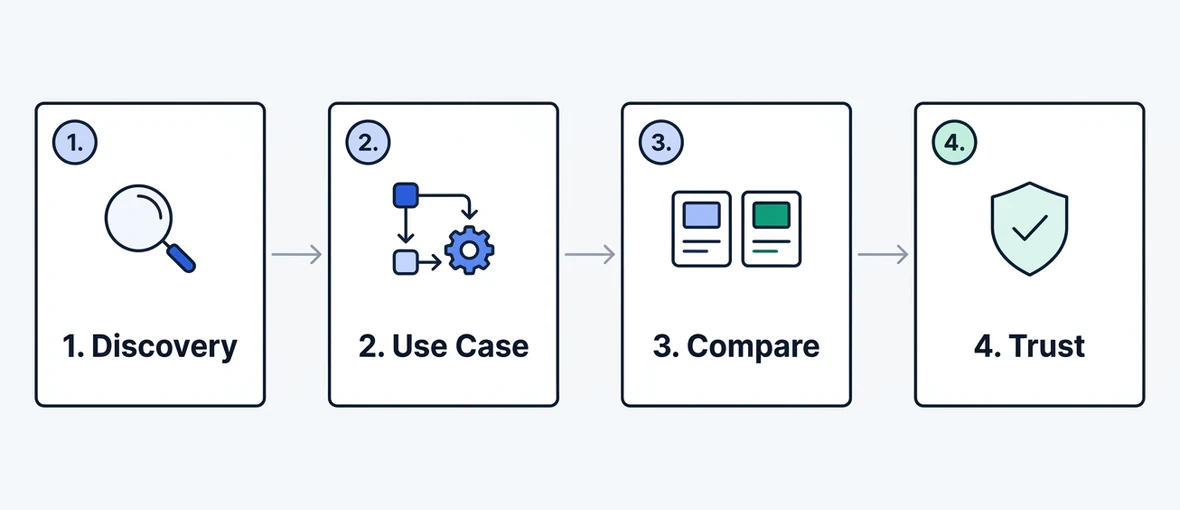
- Category discovery (non-branded): broad evaluation queries where the buyer has not picked a vendor yet (e.g., "What is the best payroll software for a 30-person US remote company?").
- Use-case and problem prompts: task-oriented questions triggered by a specific workflow bottleneck (e.g., "How do B2B SaaS teams automate SOC 2 evidence collection?").
- Comparison and alternative prompts: mid-funnel prompts naming competitors directly (e.g., "AcmeFlow vs. RivalOps for mid-market operations" or "Alternatives to legacy approval tools under $500/month").
- Branded trust and objection prompts: late-stage verification questions (e.g., "Is AcmeFlow HIPAA compliant?" or "What are the main limitations of AcmeFlow?").
Test Multiple Phrasings for Each Intent
Because small wording changes can alter which web queries an AI engine triggers behind the scenes, write two to three natural phrasings for your most commercially important buyer jobs. Write prompts the way a US buyer actually types instead of stuffing exact-match SEO keywords.
1. Discovery: "Best workflow approval software for mid-size US marketing teams"
2. Discovery (phrasing B): "Top tools to replace email-based procurement approvals for a 75-person company"
3. Comparison: "AcmeFlow vs. RivalOps: pricing, integrations, and ease of setup"
4. Branded trust: "Does AcmeFlow support Okta SSO and audit logs?"
3. Setting Controlled Test Conditions
Comparing an AI check run in New York on Monday with a logged-in personal ChatGPT history against a check run from Europe on Friday with web search turned off introduces noise that invalidates trend comparisons. Before collecting your baseline, lock five parameters and keep them identical across measurement waves:
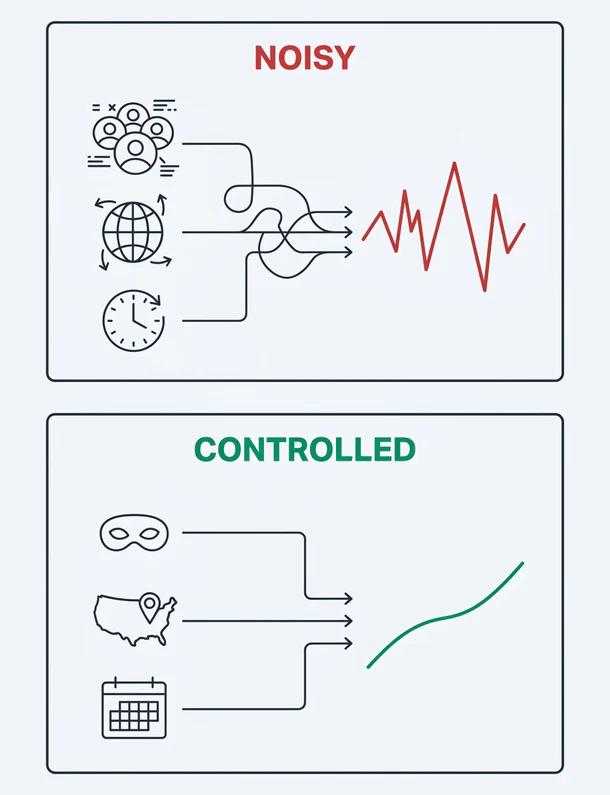
- Choose the target AI engines relevant to your buyers, usually ChatGPT (with web search active), Perplexity, Google Gemini, and Google AI Overviews. Never mix a closed-book offline model with a live web-grounded engine in the same average without labeling the difference.
- Set a consistent US location. For local businesses, specify the metro area such as Austin, TX or Chicago, IL inside the prompt or search proxy.
- Keep prompts in US English and record whether currency or compliance assumptions (USD, SOC 2, HIPAA, US state rules) are explicit.
- Use fresh, unpersonalized sessions (new chat thread with memory disabled, or an isolated incognito/API environment) so prior conversation context does not bias which brands appear.
- Set a fixed check cadence (weekly for priority commercial prompts, or bi-weekly/monthly for broader discovery sets) and log the exact date and model mode used.
4. Interactive Audit Worksheet & Metric Calculator
Use the interactive worksheet below to practice logging multi-engine checks with the illustrative AcmeFlow sample, or clear the rows and enter your own manual observations to compute exact Mention Rate and Citation Rate denominators and export a CSV/Markdown template.
Interactive AI Audit Worksheet & Metric Calculator
Log manual checks across AI engines or load the illustrative AcmeFlow dataset to calculate exact Mention Rate and Citation Rate denominators and export a CSV/Markdown checklist.
| Engine | Prompt | Outcome | Cited URL / Competitors | Action |
|---|
How to use this worksheet
Every percentage divides by the exact number of logged responses (N) so you never confuse mention frequency with website citations.
Click Download CSV checklist or Copy Markdown table to reuse this layout for weekly or bi-weekly audit runs.
5. Manual Audit Workflow & Tracking Table Template
Whether you track results in a spreadsheet or a dedicated database, standardize your audit log before running prompts. A clean log captures both qualitative context (how the model describes you) and quantitative indicators (rank and cited URLs).
| Column | What to Record | Example Entry (Illustrative) |
|---|---|---|
Date | ISO date of the check run | 2026-11-12 |
AI Engine | Platform and search mode | ChatGPT (Web Search) |
Prompt | Exact buyer question submitted | Best workflow software for 50-person US teams |
Brand | Target brand + aliases checked | AcmeFlow |
Brand Mentioned | Yes / No | Yes |
Context / Sentiment | Recommended, neutral mention, or caveat | Recommended for fast setup; notes limited ERP connectors |
List Position | Order in ranked/bulleted list (or N/A) | #2 of 4 |
Cited URLs | All source links shown in answer/footnotes | g2.com/... , acmeflow.example/guide |
Competitors Named | Rivals mentioned in the same answer | RivalOps (#1), StackFlow (#3) |
Always paste the raw response snippet or save a link/archive in an adjacent notes column. Six weeks later, knowing why a model changed its wording is far more valuable than seeing a binary Yes/No flip.
| Engine | Intent | Mentioned | Position | Top Cited Domain | Competitors |
|---|---|---|---|---|---|
ChatGPT | Category Discovery | Yes | #2 | acmeflow.example | RivalOps, StackFlow |
Perplexity | Category Discovery | No | — | g2.com | RivalOps, WorkGrid |
Gemini | Category Discovery | Yes | #3 | zapier.com | RivalOps |
AI Overviews | Category Discovery | No | — | capterra.com | RivalOps, StackFlow |
6. How to Calculate AI Visibility Metrics (Worked Example)
Percentages in AI visibility reporting are meaningless unless the denominator is stated explicitly. Use two separate core formulas so executives never mistake text mentions for website traffic links.
Domain Citation Rate (%) = (Responses Citing Your Domain / Total Tested Responses) × 100
Worked Illustrative Example: AcmeFlow (20 Runs)
Note: The figures below are a fictional teaching example created to demonstrate the math. They are not measurements of a real company.
Suppose the marketing team at AcmeFlow tests 5 buyer prompts across 4 AI engines (ChatGPT, Perplexity, Gemini, Google AI Overviews) on the same day under US English settings. That gives an explicit denominator of 20 tested responses (5 prompts × 4 engines):
- AcmeFlow Mention Rate: AcmeFlow appears in 9 out of 20 responses →
9 / 20 × 100% = 45.0%. - AcmeFlow Domain Citation Rate: A link to
acmeflow.exampleis cited in 4 out of 20 responses →4 / 20 × 100% = 20.0%. - Competitor Benchmark (same 20-response denominator): RivalOps appears in 14 / 20 (70.0%) responses, while StackFlow appears in 6 / 20 (30.0%).
7. Competitor & Source Gap Analysis
Once your baseline table is populated, group losses into four diagnostic categories instead of treating every missed prompt as identical:
- Missing questions: high-intent discovery or use-case prompts where competitors appear consistently and your brand is absent across engines.
- Factual drift or stale context: answers that mention your brand with outdated pricing, missing integrations, or old positioning, often caused by stale third-party directories or unclear product docs.
- Third-party citation dominance: queries where AI engines lean on the same review portals (G2, Capterra, TrustRadius), editorial comparison roundups, or Reddit threads where competitors appear and your brand is absent.
- Shallow framing: prompts where your brand sits at the bottom without differentiating context (e.g., mentioned as "also consider" with no clear fit statement), signaling weak topic association.
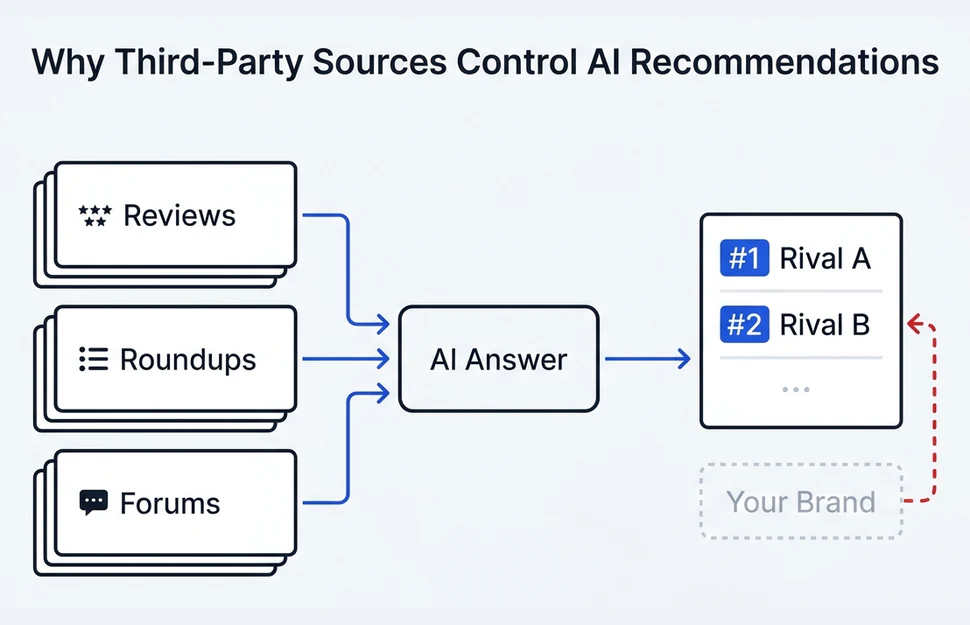
Sort the Cited URLs column by domain frequency across all competitor-winning runs. In practice, you will often find 5 to 10 recurring third-party domains feeding multiple AI engines for your niche.
8. Turning Observations Into an Action Plan
Treat every optimization move as a testable hypothesis rather than a guaranteed lever. No markup tag, listicle format, or prompt trick forces an LLM to cite a brand, because AI models combine signals across your own site and external sources.
- Clarify owned facts and pricing: audit your product, pricing, security, and integration pages so core facts (starting price, deployment model, supported integrations, US compliance certifications) sit in crawlable HTML rather than inside PDFs or client-side tabs.
- Close content gaps on comparisons: when buyers ask comparison or use-case questions that your docs ignore, publish factual comparison and implementation guides backed by verifiable specs.
- Verify bot and crawler access: confirm your
robots.txt, CDN/WAF rules, and server-side rendering allow search and AI retrieval crawlers (including OpenAI crawlers (OAI-SearchBot),PerplexityBot, and Googlebot; see Google AI features documentation) so they can read primary page content without paywalls or broken JS rendering. - Close third-party citation gaps: prioritize the review categories, partner roundups, and community threads that appeared repeatedly in your audit's
Cited URLscolumn. Updating an incomplete vendor profile or earning inclusion in a category comparison supplies the external evidence AI retrieval pulls.
Fix 15 to 30 US buyer questions across discovery, comparison, and trust.
Log mentions, rank, competitors, and cited URLs under identical settings.
Fix owned factual gaps, crawlability, and missing third-party citations.
Re-run the exact same prompt set in 2 to 4 weeks to verify directional shift.
9. Repeating Measurements & Scaling Beyond Spreadsheets
AI responses vary from run to run because models sample probabilistically. Running the same prompt twice in a row can shift phrasing or brand order due to sampling temperature, live web index refreshes, and quiet model updates.
Keep three guardrails in mind as you track trends over time:
- Watch out for small-sample noise: on a 10-prompt test, one brand flip moves your score by 10 percentage points. Wait for sustained directional movement across 2 to 3 consecutive measurement cycles before drawing conclusions from a single run.
- Keep the baseline prompt cohort intact: if you add 10 new prompts in Month 2, track them separately so Month 1 and Month 2 numbers stay directly comparable.
- Know when spreadsheets stop scaling: manual checks work well for 10 to 20 prompts on one brand. Once a marketing team or US agency needs to monitor multiple product lines, regional markets, or several client accounts every week, automated tracking saves hours of copy-pasting and preserves raw historical snapshots.
Frequently asked questions
How can I check AI brand mentions manually?
Create a fixed list of 10 to 20 buyer-intent prompts, open clean incognito or unpersonalized sessions in ChatGPT, Perplexity, Gemini, and Google Search (for AI Overviews), run each prompt under consistent US English settings, and log whether your brand is mentioned, its list position, cited URLs, and competitors in a spreadsheet.
How often should we check brand mentions in AI search?
Weekly or bi-weekly checks work well for your highest-priority commercial and comparison prompts, while monthly checks are usually sufficient for broader informational queries. Running the same prompt set on a fixed cadence helps separate real directional shifts from single-run variation.
Why do AI answers differ for the same prompt across engines and runs?
Different AI platforms use different underlying models, live web-retrieval pipelines, and source-ranking rules. Even within the same engine, probabilistic text generation and real-time search index updates can change which brands or citations appear from one run to the next.
Can you see all the prompts real users type into AI search engines?
No. Unlike classic Google Search Console query reports for your own site, AI platforms do not expose complete logs of every private prompt users type. Teams build representative prompt sets from customer interviews, sales call objections, support tickets, and traditional search intent data.
What is the difference between a brand mention and a source citation?
A brand mention occurs when the AI names your company or product inside the written answer. A source citation is a clickable URL reference pointing to a specific web page (either yours or a third-party site) used to ground claims in the answer.
Next steps & related pages
Want a baseline visibility check for your brand?
Save the CSV checklist above for manual audits, or request a baseline check on your target US buyer prompt while our automated tracking workspace rolls out.