To improve brand visibility in AI search engines, confirm that AI and search crawlers can read your pricing, integration, and comparison pages in plain HTML, standardize your brand facts across third-party directories and review sites, build direct comparison content for the buyer questions competitors win, and re-test a locked prompt set every 2 to 4 weeks.
1. Why Owned SEO Alone Rarely Moves AI Recommendations
Traditional search optimization focuses heavily on ranking your own URLs for keyword queries. AI answer engines build shortlists differently: they combine facts from your domain with external validation from software directories, editorial comparison roundups, and community forums.
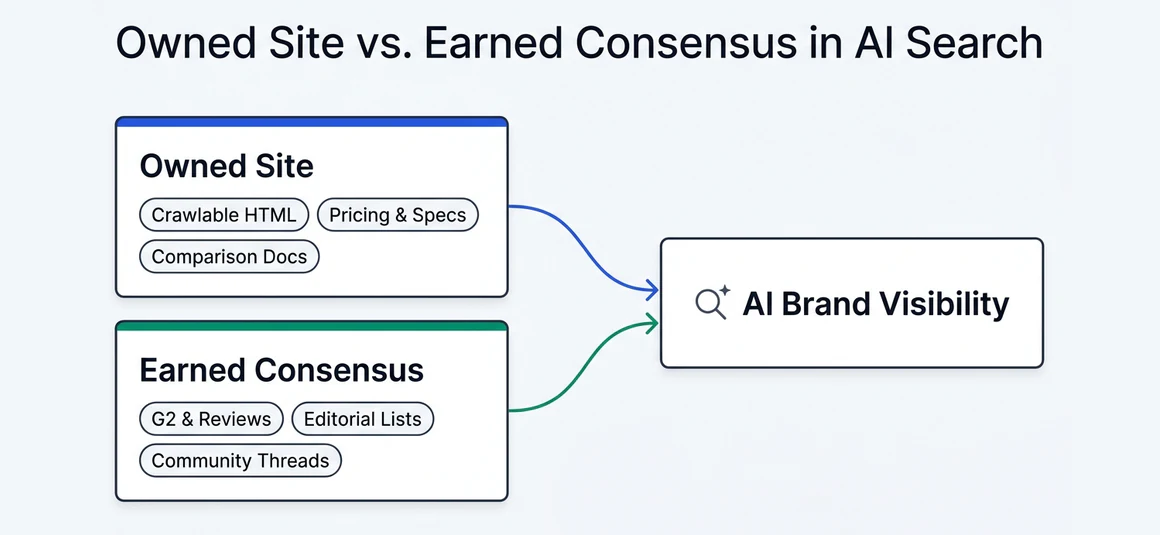
If your product pages are vague about pricing, deployment model, or target customer size, an AI engine either skips your brand or guesses from stale directory listings. Even with flawless on-site pages, a brand absent from category roundups and peer reviews loses non-branded buyer recommendations to rivals that show up in those sources.
2. Verify Bot Access and Plain-HTML Readability
Before rewriting copy, verify that live retrieval crawlers can fetch your core commercial pages cleanly. Many US SaaS and e-commerce sites accidentally block retrieval bots behind WAF rules, aggressive bot challenges, or client-side tabs that hide specs from simple HTML fetchers.
- Check your
robots.txtand CDN rules for search and AI retrieval user agents, including OpenAI crawlers (OAI-SearchBot),PerplexityBot, and Googlebot. - Render key product capabilities, starting pricing, US compliance certifications (SOC 2, HIPAA, FedRAMP), and integration lists directly in server-rendered HTML rather than locking them inside gated PDFs.
- Add clean Schema.org structured data (
Organization,Product,SoftwareApplication, andFAQPagewhere appropriate) so machine parsers see unambiguous entity names, URLs, and category attributes.
OAI-SearchBot or PerplexityBot is blocked before investing in new pages.3. Publish Answer-First Comparison and Use-Case Pages
Buyers rarely prompt AI tools with two-word keywords. They ask scenario-driven questions such as "Best SOC 2 automation platform for a 40-person fintech" or "Tool A vs. Tool B for multi-location clinics". Generic landing pages filled with slogans give retrieval models nothing specific to quote.
| Buyer Question Type | What Owned Pages Usually Omit | What to Publish Instead |
|---|---|---|
| Category discovery | Explicit ideal customer size and industry fit | Clear positioning statement naming team size, vertical, and core job |
| Pricing and tiers | Hidden enterprise pricing with no anchor | Transparent plan structure, billing unit, and entry tier |
| Competitor vs. brand | No honest comparison page on your domain | Factual side-by-side matrix covering setup time, limits, and trade-offs |
| Integration fit | Logo wall with zero technical details | Dedicated integration pages stating sync direction, triggers, and auth |
Open every comparison or solution page with a direct, verifiable summary in the first paragraph, followed by a compact spec table. Plain factual statements carry better extractability than promotional adjectives.
4. Standardize Brand Entity Facts and Close Third-Party Gaps
When an AI engine cross-checks your company across multiple domains, conflicting descriptions weaken confidence. A product described as an "all-in-one marketing suite" on LinkedIn, "email automation" on G2, and "CRM software" on its homepage creates mixed category associations.
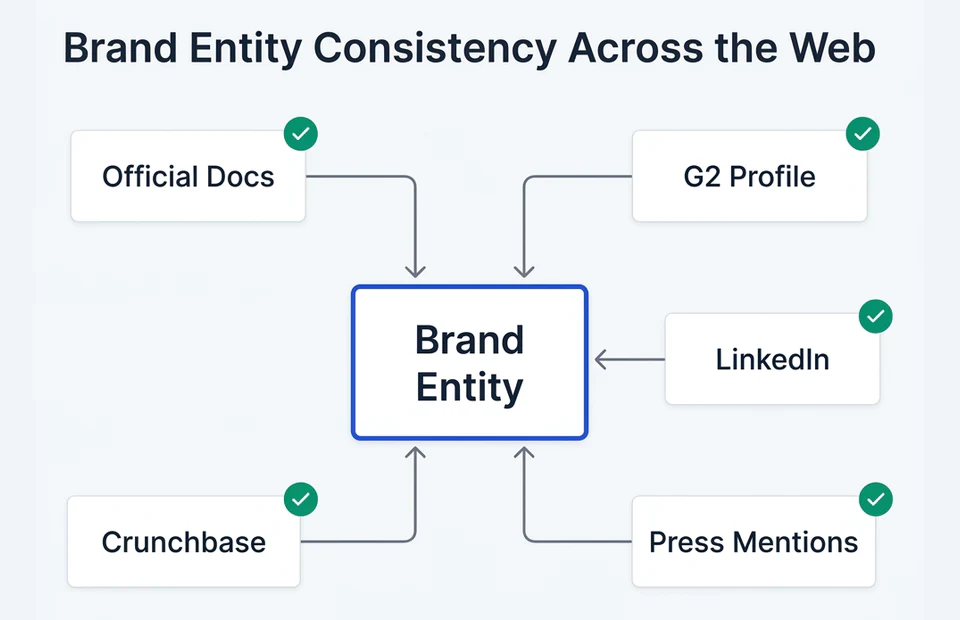
- Audit your listings on G2, Capterra, TrustRadius, LinkedIn, and Crunchbase so your primary category, tagline, and core feature list match your current homepage.
- Export the recurring third-party domains cited in your competitor prompt audits. In most B2B niches, 5 to 10 editorial roundups, review categories, and community threads supply most external citations.
- Close factual omissions on those external pages through updated vendor profiles, recent verified customer reviews, partner directory submissions, and factual contributions to industry comparisons.
5. Run Visibility Changes as a 2-to-4-Week Hypothesis Loop
No single tag or content format forces an LLM to recommend your brand. Treat every page update, schema fix, or third-party listing update as a hypothesis tested against a locked prompt baseline.
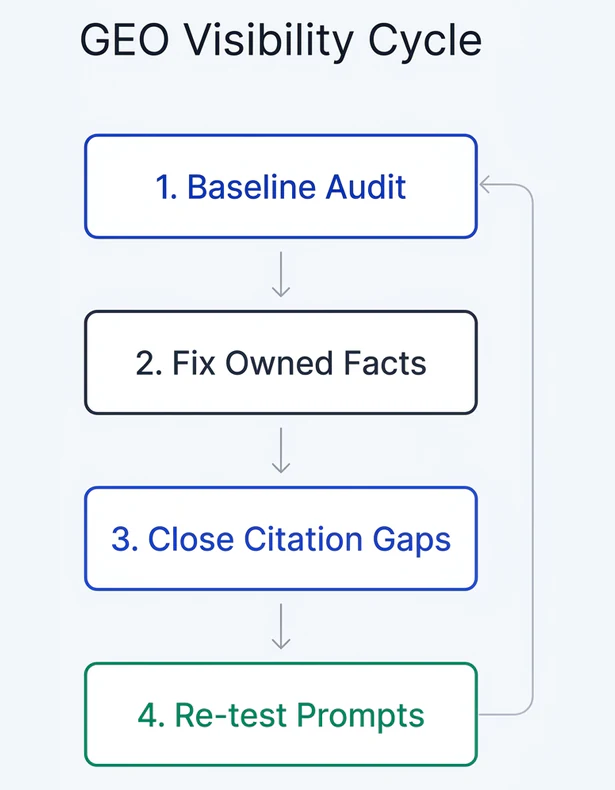
- Record a baseline across 15 to 30 fixed US buyer prompts using our AI mention tracking worksheet.
- Fix owned factual gaps first (pricing clarity, crawler access, and missing comparison pages), since your team controls those edits directly.
- Target the external review portals and editorial roundups where competitors appear repeatedly and your brand is missing.
- Re-run the identical prompt cohort 2 to 4 weeks later across ChatGPT, Perplexity, Gemini, and Google AI Overviews to separate sustained directional gains from single-run noise.
Frequently asked questions
How long does it take to see brand visibility changes in AI search engines?
Live web-grounded engines like Perplexity, ChatGPT Search, and Google AI Overviews can pick up owned-site updates within days to a few weeks once pages are re-crawled, while changes driven by third-party reviews and model memory typically take several weeks or months.
Does adding llms.txt guarantee better AI visibility?
No. While publishing a clean llms.txt summary is harmless and helpful for documentation-heavy sites, major AI search engines rely primarily on standard web crawling, third-party citations, and structured HTML rather than treating llms.txt as a ranking factor.
What matters more for AI recommendations: my own blog or third-party reviews?
For non-branded buyer questions like 'best tool for X', third-party review portals, comparison roundups, and community discussions carry heavy weight because AI engines use external consensus to build objective shortlists. Your own site matters most for accurate pricing, specs, and direct comparisons.
Can small B2B brands outrank larger incumbents in AI answers?
Yes, especially on specific use-case, team-size, or vertical prompts where a focused vendor states clear fit, transparent pricing, and strong niche reviews while larger incumbents publish broad enterprise copy.
Next steps & related pages
Want a baseline visibility check for your brand?
Save the CSV checklist above for manual audits, or request a baseline check on your target US buyer prompt while our automated tracking workspace rolls out.