Answer Engine Optimization (AEO) is the practice of structuring your website content, technical markup, and third-party brand signals so AI platforms such as ChatGPT, Perplexity, Gemini, and Google AI Overviews can retrieve, verify, and cite your company inside direct answers and vendor shortlists.
1. What Answer Engine Optimization Actually Does
Traditional search engines return a list of blue links and leave the synthesis work to the buyer. Answer engines reverse that workflow: they interpret a multi-constraint prompt, fetch passages from multiple documents, and assemble one direct response with inline brand recommendations and footnote links.
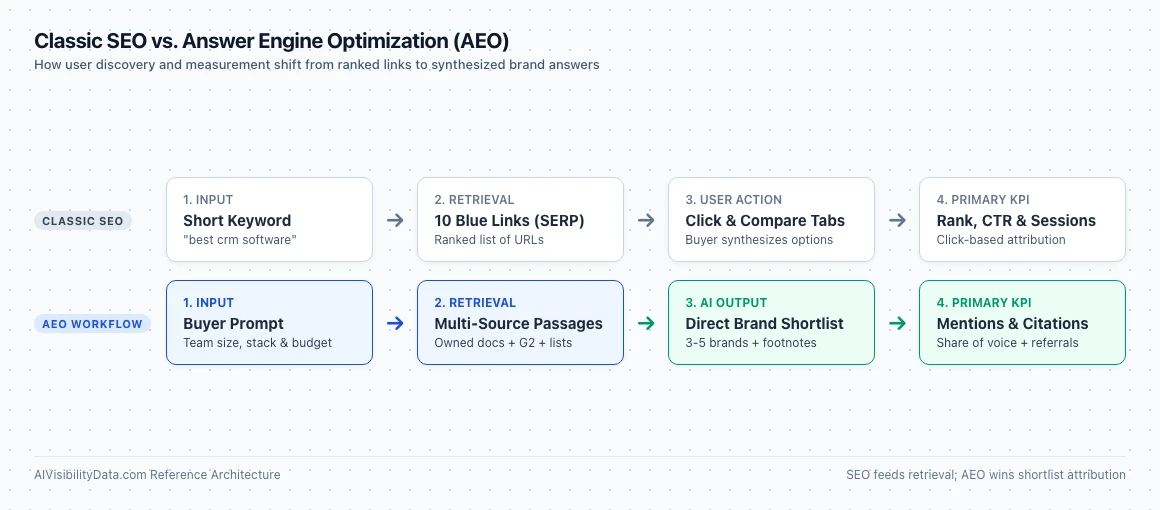
For B2B software and service teams, this means buyers frequently narrow down a 3-to-5-vendor shortlist inside ChatGPT or Perplexity before they ever open a company homepage. AEO focuses on making sure your brand appears accurately in those early shortlist answers.
2. How Answer Engines Extract and Cite Your Pages
Answer engines rarely read an entire 3,000-word blog post from top to bottom during live retrieval. Instead, their retrieval layer chunks pages into self-contained sections and looks for explicit answers that match the user's question and constraints.
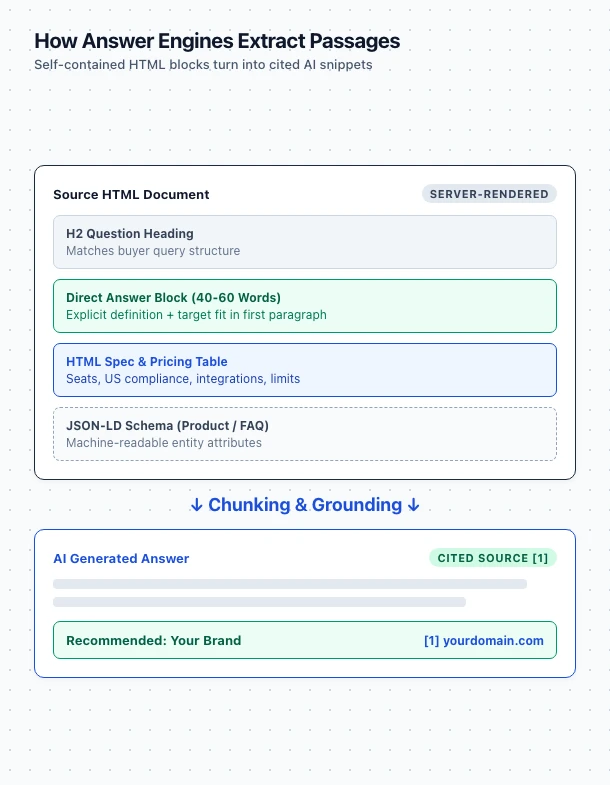
- Use question-style or task-specific headings (
H2andH3) that mirror how buyers phrase real problems. - Place a 40-to-60-word direct answer immediately under the heading before expanding into nuances or edge cases.
- Keep key product constraints (pricing tiers, supported integrations, compliance standards, and target team sizes) inside HTML tables rather than buried in PDFs or screenshots.
- Implement valid structured data (JSON-LD) for Organization, Product, and FAQ blocks so machines can parse entity attributes without ambiguity.
3. How AEO Compares to Traditional SEO
AEO builds on technical SEO fundamentals such as clean crawling and fast server-rendered HTML, yet the target outputs and measurement signals differ in four practical ways:
| Dimension | Traditional SEO | Answer Engine Optimization (AEO) |
|---|---|---|
| User input | Short 2-to-4-word keyword queries | Conversational prompts with budget, stack, and role constraints |
| Primary output | Ranked list of 10+ web URLs | Synthesized paragraph with 3 to 5 named brands and citations |
| Main signals | On-page relevance, backlinks, UX metrics | Passage clarity, crawler access, and multi-site brand consensus |
| Core metrics | Keyword rank, organic CTR, sessions | Mention rate, citation share, sentiment accuracy, AI referrals |
Strong organic rankings still help because Google AI Overviews, Perplexity, and ChatGPT Search draw heavily from indexed web results, yet ranking #4 on Google no longer guarantees a mention if competitors have clearer third-party validation.
4. The Three Pillars of a Working AEO Program
Effective AEO programs divide work across three concrete areas rather than treating AI visibility as a pure copywriting exercise.
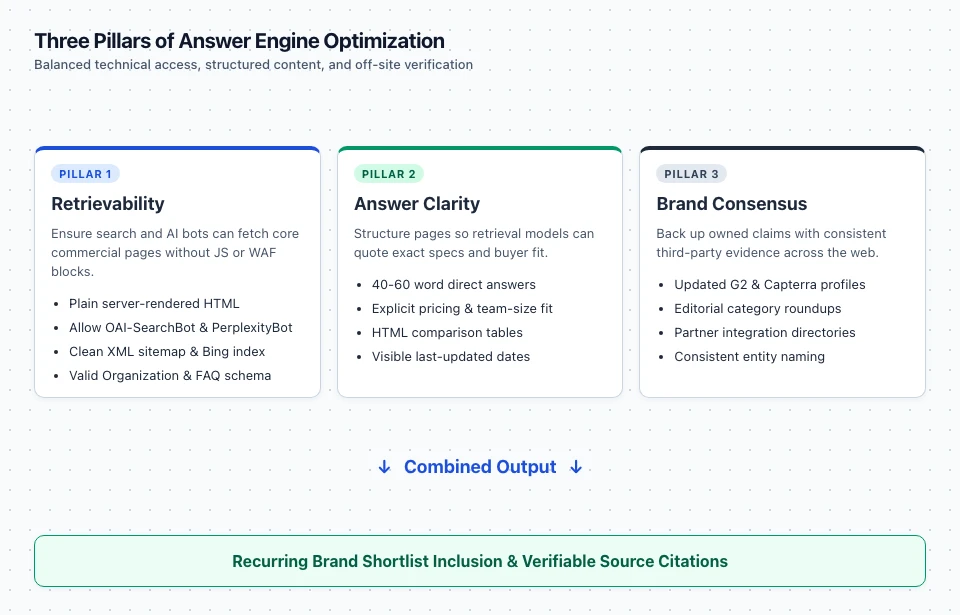
- Verify crawler access in
robots.txtand edge firewalls forOAI-SearchBot,PerplexityBot, andGooglebot, as documented in OpenAI's crawler specification. - Audit your core commercial pages with our AI Citation Checker to confirm critical pricing and feature tables render in plain HTML without client-side JavaScript blocks.
- Close third-party consensus gaps by updating G2, Capterra, documentation portals, and partner integration directories where answer engines cross-check vendor claims.
5. How to Start AEO in 30 Days Without Rebuilding Your Site
You do not need a full site migration to establish an AEO baseline. Start with a focused 4-step sprint:
- Pick 20 to 30 commercial buyer prompts covering category discovery, competitor alternatives, and specific use-case constraints.
- Run a baseline audit using the ChatGPT Visibility Tracker or AI Search Visibility Audit to see which rivals appear and which domains get cited.
- Rewrite the top 5 commercial landing and comparison pages with direct answer blocks, plain HTML spec tables, and visible update dates.
- Re-test the same fixed prompt set every 2 to 4 weeks alongside GA4 AI referral tracking to measure lift.
Frequently asked questions
Does Answer Engine Optimization replace SEO?
No. AEO extends SEO. Technical crawlability, fast HTML delivery, and authoritative links still feed the retrieval indexes that answer engines query.
How long does AEO take to show results?
Technical crawler fixes and HTML spec updates can influence live retrieval engines such as ChatGPT Search and Perplexity within 2 to 6 weeks, while third-party review consensus and model training updates take longer.
What is the difference between AEO and GEO?
In practice, teams use Answer Engine Optimization (AEO) and Generative Engine Optimization (GEO) to describe the same discipline: earning brand mentions and source citations inside AI-generated search responses.
Next steps & related pages
Want a baseline visibility check for your brand?
Save the CSV checklist above for manual audits, or request a baseline check on your target US buyer prompt while our automated tracking workspace rolls out.